

Guardian Angels
Can Protestants Affirm This?

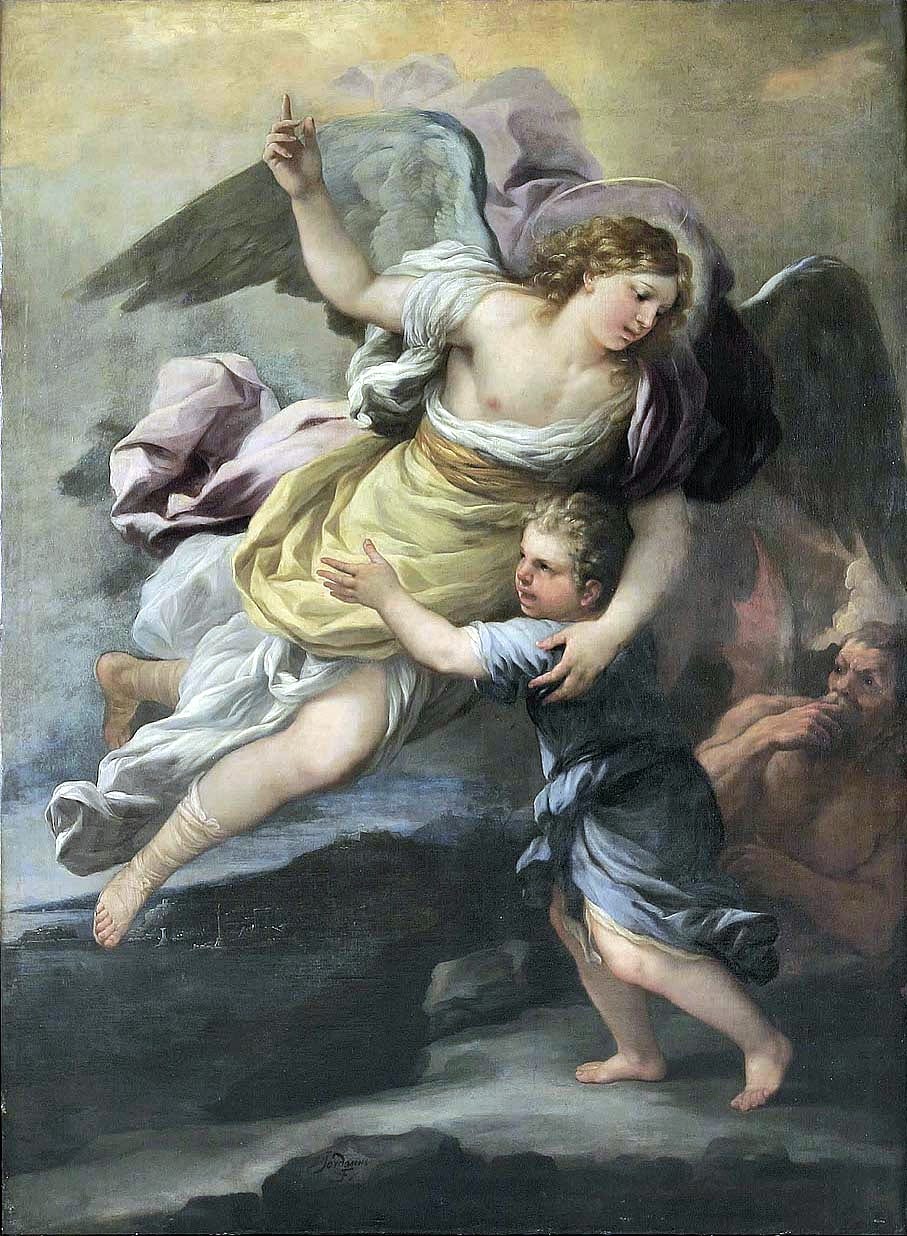
In the Western liturgical calendar, today marks the Feast of the Guardian Angels. Many Protestants believe that the notion of a guardian angel, a special angel assigned to each individual for their protection, is an exclusively Roman Catholic doctrine. Isn’t this just another extra-biblical tradition added over time by the Catholic Church that goes beyond what the Scriptures actually teach? In my view, the matter isn’t quite that simple.
A General Biblical Principle: Angels Guard.
The idea that certain spiritual beings have a special assignment to protect God’s people can be clearly demonstrated from Scripture. One of the primary functions of the angels—these spiritual messengers and servants of God—is the protection of God’s people. Consider, for example, Psalm 91:11-12:
For he will give his angels orders concerning you,
to protect you in all your ways.
They will support you with their hands
so that you will not strike your foot against a stone.
Bible readers will recognize this as the passage that Satan misapplied in his temptation of Jesus in the wilderness (Matt. 4:6). But that temptation to test God’s protection does not undermine the Psalm’s original intention: the angels are, indeed, given orders to protect and support God’s people. Psalm 34:7 teaches the same truth: “The angel of the Lord encamps around those who fear him, and rescues them.” This is not an absolute promise that no harm will ever come against believers. Far less is it an excuse for a foolhardy testing of God’s care. But it does state a general principle: The holy angels are sent by God to guard and guide his people.
A Special Case: Princes of the Nations
The Old Testament also teaches that certain angels are given charge over the protection of particular nations. Michael is referred to as the “prince” of Israel (note the possessive, “your prince,” in Daniel 10:21). In this role, he is commissioned to “stand watch” over Israel (Dan. 12:1) and to fight against their spiritual enemies. There are other princes, who appear to have charge over other nations—some who join with Michael and others whom he opposes (Dan. 10:13, 20-21). These passages seem to indicate that the affairs of men and nations are not merely material, this-worldly conflicts, but also involve unseen, spiritual battles among the principalities and powers. But the relevant point for the guardian angels is the truth taught here that angels (and demons, apparently) are given charge over particular nations. Michael is “your angel,” the Hebrews are told. Many Christian interpreters over the centuries have concluded, by biblical-theological extension, that Michael is the archangel who protects the church against the schemes of Satan himself (see Rev. 12:7; perhaps each local church has its own angel as well? See Rev. 2-3).
What about Individuals?
The idea that certain angels are sent to protect particular individuals is indicated in at least a couple New Testament passages as well. The standard prooftext for the guardian angels is Matthew 18:10:
“See to it that you don’t despise one of these little ones, because I tell you that in heaven their angels continually view the face of my Father in heaven.”
In context, the “little ones” Jesus references here seems intentionally ambiguous. Is it the literal children he often uses as an object lesson (Matt. 18:2) or is it a reference to his followers, who are to become as little children in humility and faith? The answer is probably both, though by this point in the passage, the emphasis has shifted to the lost sheep Jesus is seeking (see v. 12-14).
But the most interesting detail here is the possessive pronoun Jesus uses in v. 10: “their angels” (hoi angeloi autōn). The little ones have angels, who continually see the face of Jesus’ Father in heaven—that is, they report to God himself and will avenge any mistreatment of God’s children.
In another fascinating passage, when Peter had miraculously escaped prison (with the help of an angel) and knocked at the door to the house where the church was gathered, they wondered whether it was “his angel” who had visited them (Acts 12:15). Again, the possessive pronoun is interesting. These early Christians apparently believed that Peter had an angel (who could even speak with his voice as a kind of spiritual doppelganger! They thought this was a more likely explanation than it being Peter himself at the gate). Now, perhaps they were wrong in their assumption that Peter had an angel. Maybe this detail is merely descriptive of their beliefs and is not intended to be prescriptive in terms of what we should believe. At the very least, it is instructive that these early Jewish Christians had a category for a believer having an angel as a special protector. As it turns out, belief in guardian angels was fairly common in the Judaism of the time (see, for example, the book of Tobit, which recounts the protection given to Tobias by the archangel Raphael).
The Witness of the Church Fathers
In response to this biblical teaching, the perspective of the church fathers is fairly uniform: angels are commissioned to protect both communities and individual persons. The “personalist” interpretation of the guardian angels, to use Serge-Thomas Bonino’s phrase, was plainly taught by many prominent church fathers. The doctrine is found as far back as the Apostolic Fathers (Barnabas, Hermas, and Clement of Alexandria). Tertullian and Origen give their assent as well. Origen, commenting on Matthew 18:10, writes,
“Each believer, although the humblest in the Church, is said to be attended by an angel, who is declared by the Saviour always to behold the face of God the Father, and…this angel [is] certainly one with the object of his guardianship” (On First Principles, 2.10.7)
Basil of Caesarea in the fourth century summarizes the view that by then had become commonplace:
“No one will deny that every believer has an angel that accompanies him, acting like a kind of pedagogue [teacher, guide] and shepherd and directing his life” (Against Eunomius, 3.1)
The text Basil cites in defense of this view is, once again, Matthew 18:10. Later, in the medieval era, when scholastic theologians like Thomas Aquinas systematize and codify the doctrine of guardian angels, they are not inventing a doctrine whole cloth. They are simply receiving and transmitting a very early interpretation of key biblical texts.
What about the Reformers?
The contemporary Protestant aversion to guardian angels is often so pronounced that we might think the Reformers themselves were foursquare against the doctrine. But in actuality, the evidence is more nuanced. For all of his other revisions to medieval angelology, Luther seems to retain the traditional doctrine of guardian angels. For example, in a sermon preached on the Feast of St. Michael, Luther says, “Also, we are to know for a certainty that every human being has his own appointed angel who looks after and watches over him.” Luther preached on this theme more than once in his annual Michaelmas sermons.
John Calvin’s witness to the guardian angels doctrine is more nuanced. His discussion of guardian angels in the Institutes is remarkably circumspect.
But whether individual angels have been assigned to individual believers for their protection, I dare not affirm with confidence. Certainly, when Daniel introduces the angel of the Persians and the angel of the Greeks (Dan. 10:13, 20; 12:1) he signifies that specific angels have been appointed as guardians over kingdoms and provinces. Christ also, when he says that the children’s angels always behold the Father’s face (Matt. 18:10), hints that there are certain angels to whom their safety has been committed. But from this I do not know whether one ought to infer that each individual has the protection of his own angel. We ought to hold as a fact that the care of each one of us is not the task of one angel only, but all with one consent watch over our salvation (Institutes of the Christian Religion, 1.14.7).
Calvin goes on to allude to the angels who rejoice at the repentance of one sinner (Luke 15:7), the angel who carries Lazarus’s soul to Abraham’s Bosom (Luke 16:22), the chariots assigned to protect Elisha (2 Kings 6:17), and Peter’s angel (Acts 12:15). In his typical fashion, Calvin does not want to speculate further than what Scripture clearly demands. His reticence is, again, remarkable: “I dare not affirm…I do not know.” Calvin’s point seems to amplify the comfort derived from the guardian angels doctrine: it may be not just one but many angels who protect us daily!
Conclusion
In sum, I am of the persuasion that Protestants have no compelling reason to deny the doctrine of guardian angels. Indeed, we have good biblical, theological, and historical reasons to affirm it. Our only caution should be limiting the number to one angel for each believer. Even if we affirm that many angels encamp around the church and each of its members individually, that should not detract from the personal nature of this angelic activity. It seems to me that one of the spiritually vivifying benefits of the guardian angels doctrine is an awareness that the angels know us personally and act personally on our behalf. Angels are personal agents, not impersonal forces. They are persons in the classical Boethian sense: like humans, they are individual substances of a rational nature (though unlike humans, they are immaterial and incorporeal). My angel(s) knows me personally, knows my weaknesses, knows the kind of guidance and protection I need, and loves me enough to provide it. Nor should Protestants be worried that guardian angels will somehow take the place that only God can fill in our lives. God is our ultimate protector, but God also uses creaturely means. Just as a human father protects his children under God’s ultimate providential care, so also our guardian angels guide and guard us as God’s angels, God’s messengers.
One key application of this doctrine is to the life of prayer. If God sends his angels to encamp around us and to protect us in all our ways, then it is fitting that we should pray for such protection. We have clear biblical warrant to pray against the wiles of the fallen angels (Matt. 6:13; 26:41; John 17:15), and by extension it is perfectly appropriate to pray for the protection of the holy angels, who wage war against the forces of darkness. One of the traditional Compline (nighttime) prayers captures this twofold spiritual prayer beautifully:
Visit this place, O Lord, we pray,
and drive far from it the snares of the enemy;
may your holy angels dwell with us and guard us in peace,
and may your blessing be always upon us;
through Jesus Christ our Lord. Amen.
The praying believer might also ask each morning that God would send her guardian angel(s) to protect and guide her throughout the day. Protestants typically do not pray to the angels (or other saints), but they should feel no hesitation to pray with and for such celestial assistance. The Roman Catholic guardian angel prayer is instructive and inspiring, even if Protestants may not feel comfortable praying it per se:
Angel of God, my guardian dear,
To whom God's love commits me here,
Ever this day, be at my side,
To light and guard,
To Rule and guide. Amen.
Note: A previous version of this post wrongly attributed a quote from Calvin to Luther. Luther seems to have more consistently affirmed the guardian angels doctrine than Calvin.